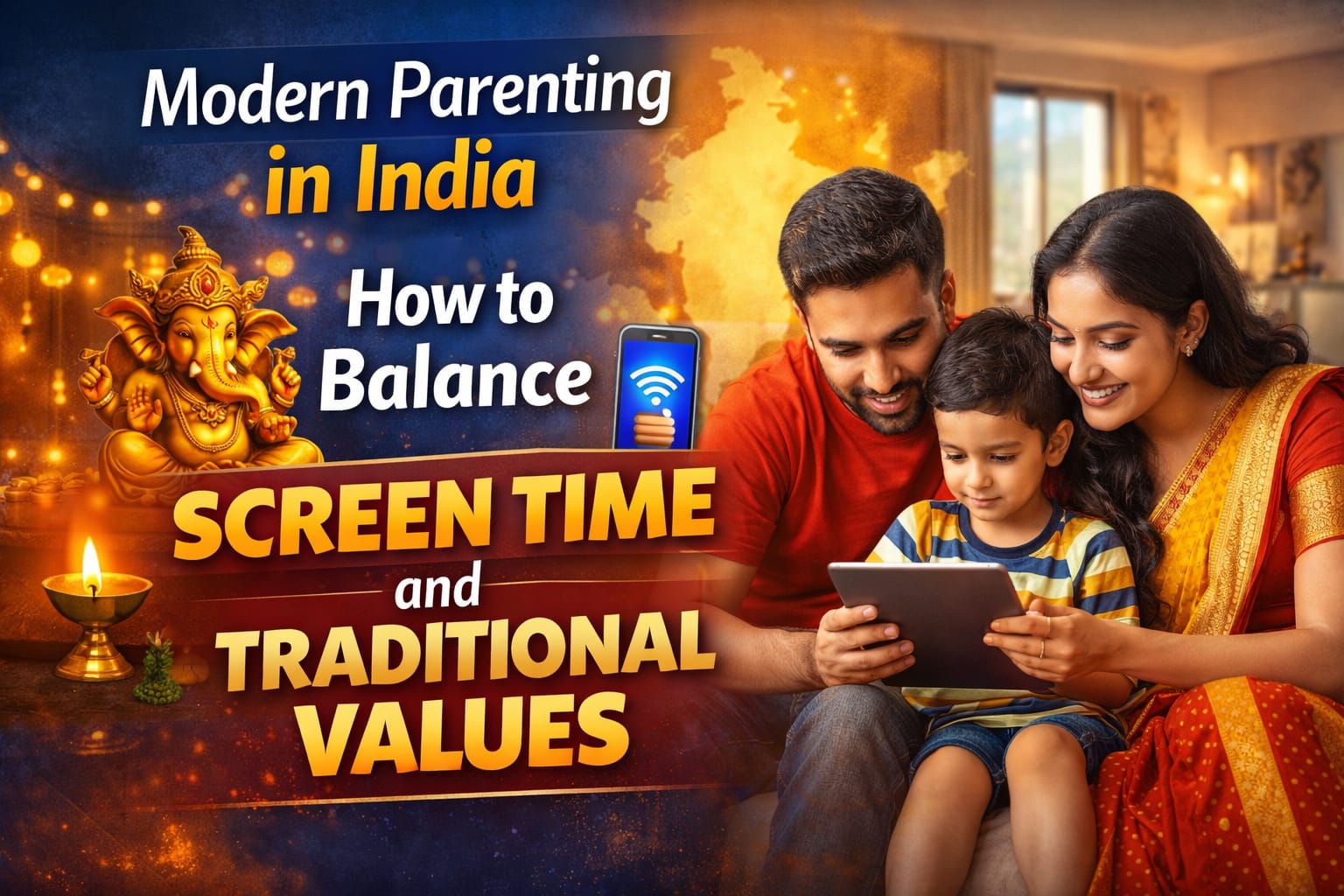
Digital Age Parenting: Raising Grounded Kids Without the Screen Wars
If you’re an Indian parent today, your struggle is vastly different from what your parents faced. Back then, the biggest challenge was getting us to come inside the house after playing cricket all evening. Today, the challenge is getting kids to look up from a tablet or a smartphone.
From rhymes on YouTube for toddlers to gaming marathons for teenagers, screens have become the “digital babysitters” of our generation. But as much as we blame technology, it’s a part of our world. The goal isn’t to ban screens—it’s to raise kids who are smarter than their devices.
Here is a realistic, human guide to parenting in modern India.
1. The “Screen Time” Battle: From Control to Connection
Most of us fall into the trap of “Snatch and Scold.” We see a child on the phone, we get frustrated, we snatch the device, and a shouting match begins.
The Fix: Instead of being a “Screen Police,” become a “Content Partner.” Sit with them for 15 minutes. Ask them what they’re watching or playing. When you show interest, the child doesn’t feel judged.
Set a “Digital Sunset” for the whole house. If you are scrolling through Instagram while telling your child to study, they won’t listen. In India, children learn more from what they see us do than what they hear us say.
2. Bringing Back the “Old School” Boredom
Remember those long summer afternoons when we had nothing to do? We invented games, we drew, we talked to neighbors. Today, the moment a child says “I’m bored,” we hand them a phone.
Boredom is the birthplace of creativity. Let them be bored. Give them a box of old newspapers, some clay, or a skipping rope. In the beginning, they will complain, but eventually, their brain will kick into “creative mode.” This builds patience—a quality that is disappearing in the world of 30-second reels.
3. The Academic Pressure vs. Emotional Intelligence
In India, the “Sharma ji ka beta” syndrome (comparing kids) is still alive. We are obsessed with marks, ranks, and coaching classes. While education is vital, we often ignore Emotional Quotient (EQ).
Teach your child how to handle failure. If they get low marks in a unit test, talk about the “process” rather than the “result.” A child who knows how to manage stress and talk about their feelings will be much more successful in the long run than a child who just tops the class but crumbles under pressure.
4. Reconnecting with Roots
In our rush to be global citizens, we sometimes miss out on the beauty of our own culture. Use meal times to tell stories about your childhood, your grandparents, or local folk tales.
Involve them in small household chores—like picking the dhaniya or setting the table. In Indian culture, “Sanskar” isn’t just about bowing down to elders; it’s about responsibility and belonging. These small tasks keep them grounded and connected to the real world.
5. The Power of “No” (With Love)
Many modern Indian parents, because they had strict childhoods, try to become “BFFs” (Best Friends Forever) with their kids. They say “Yes” to every toy, every treat, and every demand.
But kids need boundaries to feel safe. It’s okay to say “No” to a ₹5,000 toy or an extra hour of gaming. Explain the “Why” behind the “No.” Saying no doesn’t make you a bad parent; it makes you a responsible one.
6. Mental Health: The Silent Conversation
In many Indian homes, mental health is still a “taboo” topic. If your child is unusually quiet, aggressive, or withdrawn, don’t just dismiss it as “tantrums.”
Create a safe space where they can tell you anything without the fear of being slapped or judged. When a child knows that “Mummy/Papa will understand,” they don’t look for validation from strangers on the internet.
Conclusion
Parenting isn’t a 100-meter sprint; it’s a marathon. There will be days when you feel like a “Super-Parent” and days when you feel like you’re failing. That’s okay.
The most important thing you can give your child isn’t an iPad or an expensive coaching class—it’s your undivided attention. Put down your phone, look them in the eyes, and just listen. That’s where real parenting begins.
File Name:Modern Parenting in India.pdf
File Size:70KB
Pages:1
यह भी पढ़ें: Practical Vastu Tips for Modern Indian Apartments: Bring Home Peace & Prosperity